The resume that got me big tech interviews + offers
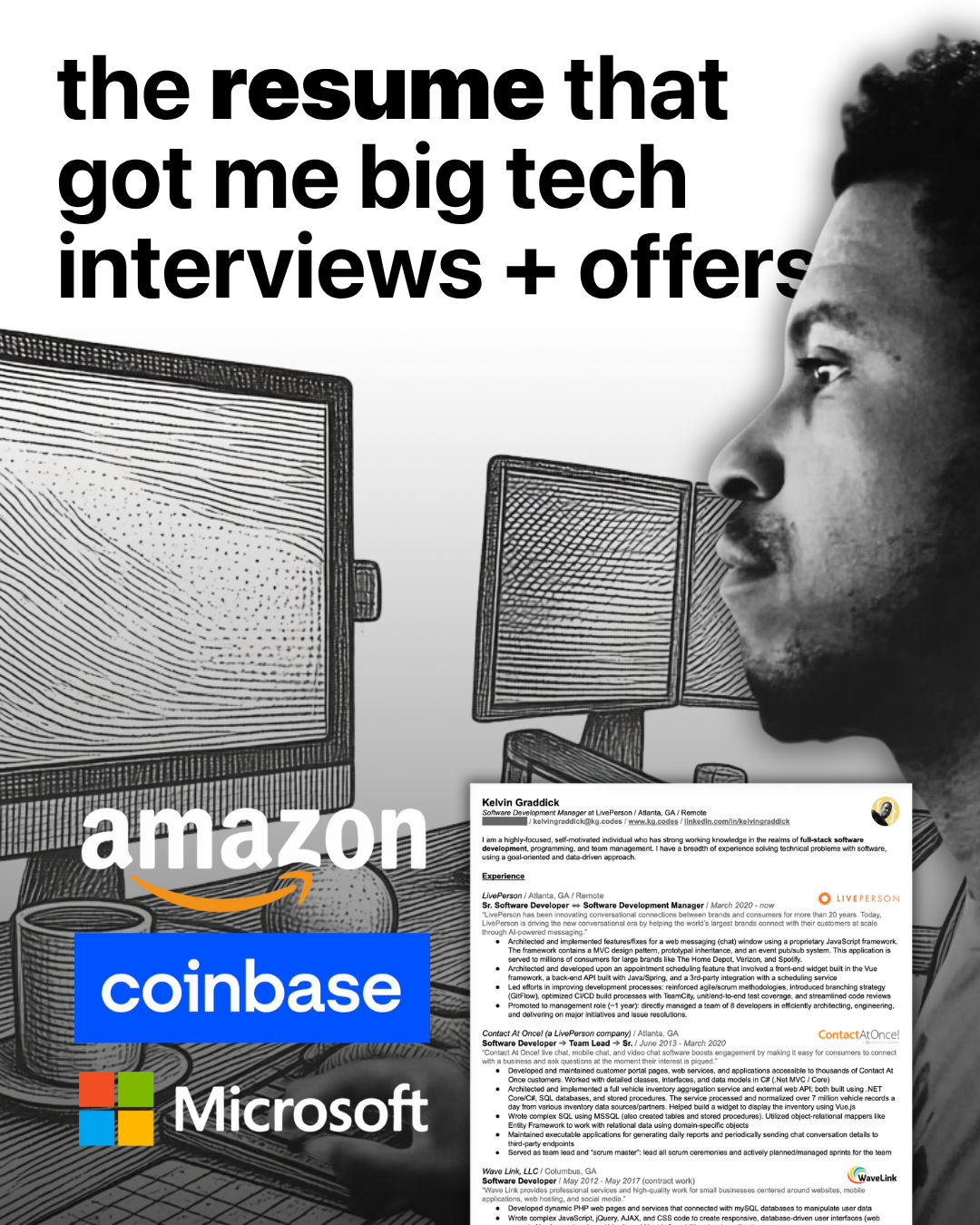
The resume that helped me get big tech interviews
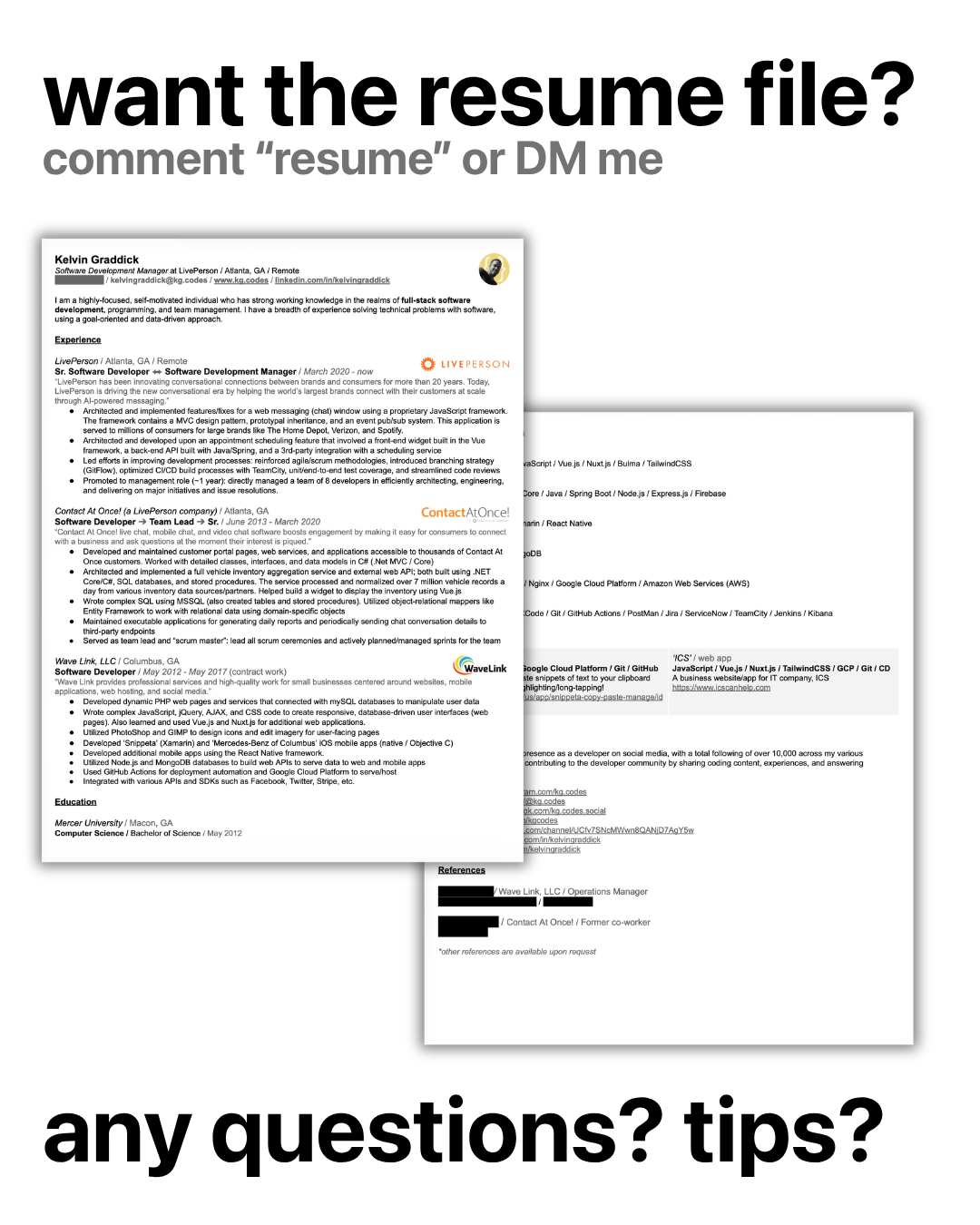
This is the resume that helped me get some big tech interviews and offers.
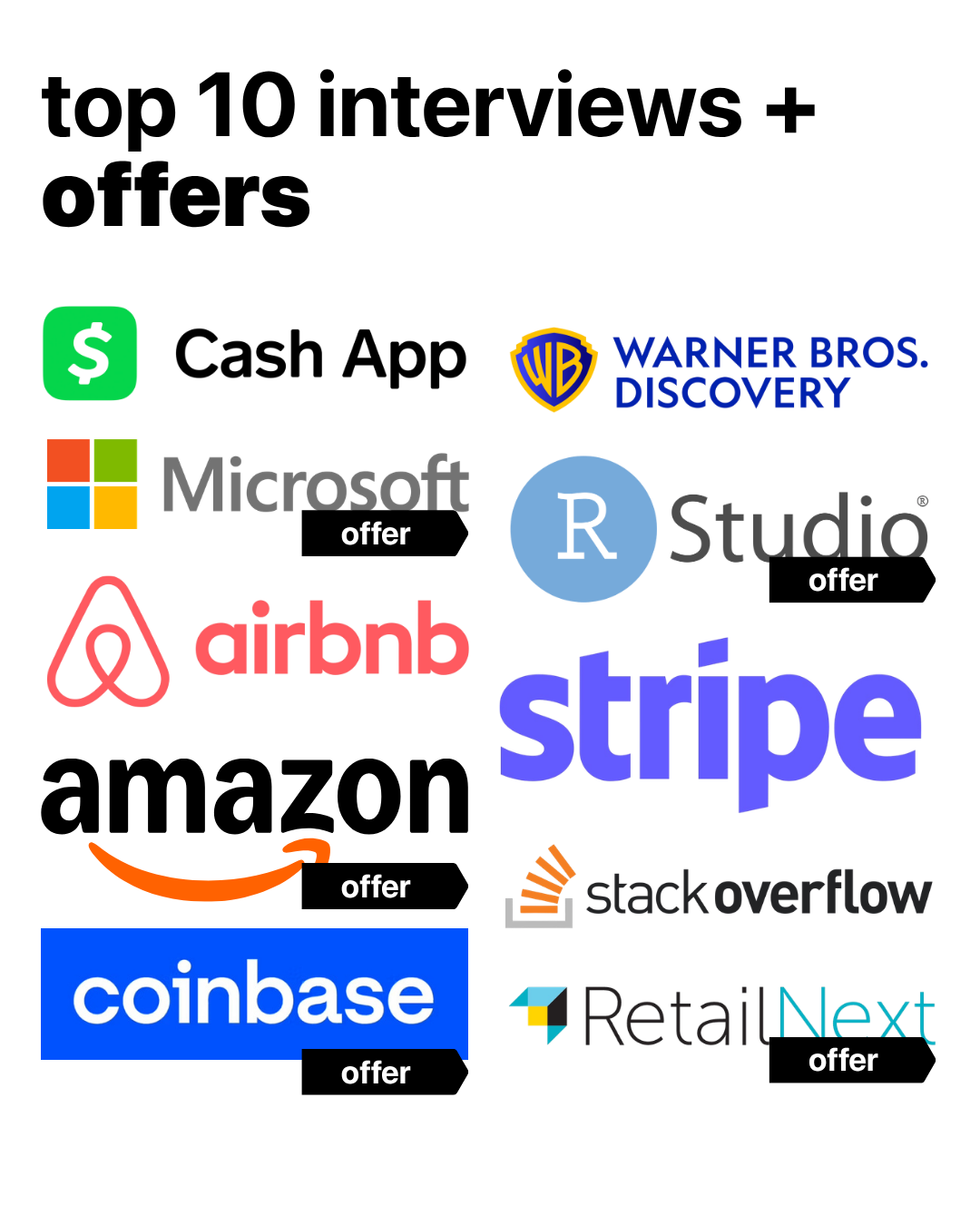
It got interviews with Airbnb, Cash App, Coinbase, Warner Bros. Discovery, Stripe, and Stack Overflow.
Those conversations led to offers from Amazon/AWS, Microsoft, Coinbase, RetailNext, and RStudio.
I am not saying the resume was perfect. I am also not saying a resume alone gets you hired. You still have to pass the interviews and back up your experience.
But the resume did its job. It helped recruiters and hiring teams understand my background quickly enough to start the conversation.
That is the part people sometimes miss. A resume is not supposed to tell your entire life story. It is supposed to help someone answer a few questions fast:
- What lane are you in?
- What level are you operating at?
- What kind of problems have you solved?
- Can your experience map to the role?
- Is there enough proof to believe the claims?
If those answers are easy to find, your resume has a much better chance.
What made this resume work
A few things I think helped mine:
- Crystal clear career goals
- Outcomes, not just tasks
- Clear progression
- Scannable skills and keywords
- Simple formatting
- Proof beyond the job title
Those are not fancy resume hacks. They are simple choices that help both people and systems understand what you do.
Google's Resume Overview says recruiters have about 30 seconds to decide whether you should be considered, and that a resume should show responsibilities plus impact. That lines up with what I tried to do here.
I wanted the resume to be easy to scan, but specific enough to prove the work.
1. Crystal clear career goals
Recruiters should understand what lane you're in within a few seconds.
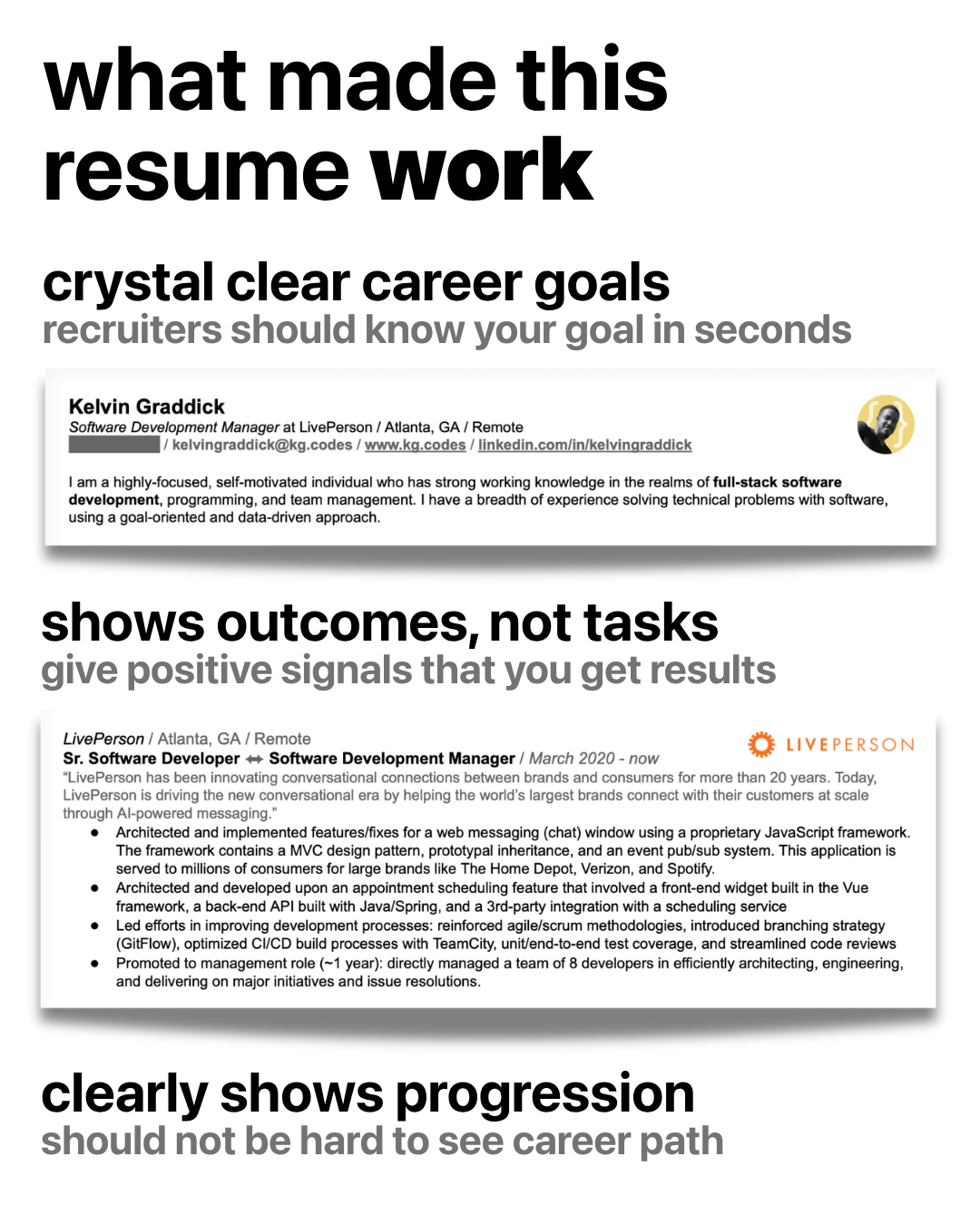
At the top of my resume, I did not try to be everything at once. The positioning was clear: Software Development Manager, with experience in full-stack software development, programming, and team management.
That matters because recruiters are usually matching against a role. If the role needs a manager, senior full-stack engineer, technical lead, or hybrid engineering leader, the resume needs to make that fit obvious.
The goal is not to cram every possible version of yourself into the first few lines. The goal is to make your current career direction easy to understand.
For me, that meant leading with:
- Full-stack software development
- Programming
- Team management
- Goal-oriented and data-driven problem solving
That is stronger than a vague summary like "hardworking technology professional with a passion for innovation."
The better question is: what job should this resume make obvious you are ready for?
2. Outcomes, not just tasks
Do not just say what you worked on. Show what changed because of the work.
A task-based resume says:
Worked on internal tools.
An outcome-based resume says:
Built internal reporting tools that reduced manual status tracking and gave the team faster visibility into production issues.
The second version is stronger because it answers the silent question: so what?
On my resume, I tried to show scale, ownership, and impact. Instead of only saying that I worked on a web messaging product, I included that the application served millions of consumers for large brands. Instead of only saying I worked on scheduling, I explained the front-end widget, back-end API, and third-party integration involved.
Yale's guide on Writing Impactful Resume Bullets recommends connecting the action, project, and result. That is a clean way to pressure-test a bullet.
For each bullet, ask:
- What did I do?
- What did I build, improve, lead, fix, or ship?
- What changed because of it?
- Can I add a number, scale marker, customer type, or team size?
Not every useful piece of work has a clean percentage attached to it. But every bullet should have a reason to exist.
3. Clear progression
Your title changes, scope, and career path should be easy to follow.
One thing I think helped my resume is that it showed progression without making the reader hunt for it.
One role showed:
Sr. Software Developer -> Software Development Manager
Another showed:
Software Developer -> Team Lead -> Sr.
That visual progression matters because it gives hiring teams a quick signal that your scope grew over time.
Career progression is not only about titles. You can show progression through larger systems, more ownership, bigger customers, mentoring, architecture work, or business-critical projects.
If your resume has multiple roles at the same company, do not flatten them into one blob. Make the growth visible. If your title did not change, show the progression through the bullets.
The reader should never have to guess whether you grew. Make it obvious.
4. Scannable skills and keywords
This helps both humans and automated resume scanners understand your background.
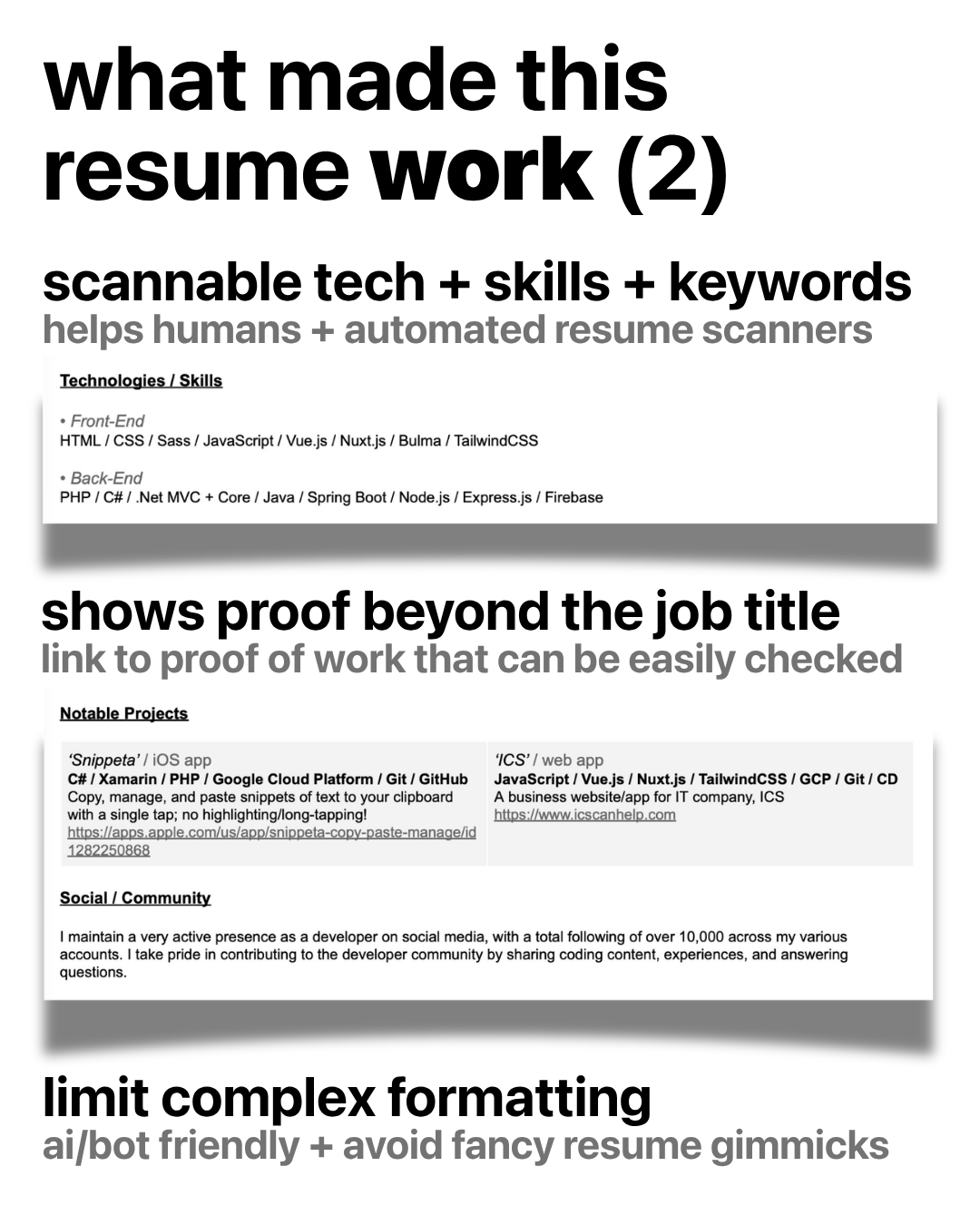
My resume had a simple Technologies / Skills section broken into categories:
- Front-End
- Back-End
- Mobile
- Database
- Hosting / Cloud
- Tooling
That made it easy to spot the technologies quickly and gave applicant tracking systems a better chance of matching the resume.
Indeed's ATS Resume Guide recommends clear section labels, simple formatting, and naturally weaving keywords from the job description into the resume.
The key word is naturally.
Do not keyword-stuff your resume until it reads like a search engine prompt. But if a role asks for React Native, JavaScript, AWS, CI/CD, Node.js, or team leadership, and you have that experience, those words should appear naturally.
I like putting skills in two places:
- A scannable skills section for quick matching
- Experience bullets where those skills are tied to actual work
Keywords get you found. Specific work makes you believable.
5. Simple formatting
Fancy layouts can look cool, but they can also make your resume harder to parse. Keep the structure clean.
This resume was not trying to win a graphic design contest. It was built to be read.
That meant:
- Clear headings
- Consistent spacing
- Simple bullets
- Obvious job titles
- Dates that were easy to follow
- No unnecessary design gimmicks
- Skills grouped in a predictable way
Simple formatting also makes your resume easier to skim on different screens. If the layout depends too much on columns, graphics, icons, or tiny text, you increase the chance that something breaks.
I would rather have a clean resume than a creative one that slows the reader down.
6. Proof beyond the job title
Projects, links, community work, and real examples can make your experience easier to believe.
One thing I included was a Notable Projects section. I also included social and community links, plus a short note about sharing coding content and answering developer questions.
That helped because the resume was not only saying "trust me, I know this stuff." It pointed to proof.
Proof can look different depending on your background: a shipped app, portfolio site, GitHub profile, technical blog, open-source work, freelance projects, or community teaching.
Harvard's piece on Resume Action Verbs makes a useful point about using active language to elevate accomplishments. I agree, but strong verbs work best when attached to proof.
Words like architected, built, led, improved, launched, and streamlined are stronger when the reader can see what you applied them to.
The more concrete the proof, the less the reader has to guess.
A quick resume checklist
Before you send your resume, I would check these things:
- Can someone understand your target role in a few seconds?
- Does the top third of the page show your strongest signal?
- Do your bullets show outcomes instead of only tasks?
- Are your most important keywords present naturally?
- Is the format simple enough for humans and ATS tools?
- Do your links, projects, or examples support your claims?
If the answer is no, do not panic. Most resumes are not broken because the person is unqualified. They are broken because the story is too hard to see.
Final thoughts
This is the resume that helped me get interviews with Airbnb, Cash App, Coinbase, Warner Bros. Discovery, Stripe, and Stack Overflow.
It helped lead to offers from Amazon/AWS, Microsoft, Coinbase, RetailNext, and RStudio.
Again, the resume was not magic. It was just clear.
It showed career goals, outcomes, progression, scannable skills, simple formatting, and proof beyond the job title.
If you are working on your own resume, that is where I would start.
Make it easy to understand your lane. Make it easy to believe your impact. Make it easy for the right opportunity to connect the dots.
And if you want me to send you the resume file, or have questions, comment "resume" or DM me.
Also feel free to share if you have any more advice.
