Should hiding AI use be illegal?
What if AI-generated content had to be labeled?
What if AI-generated content had to be labeled so users always knew when they were interacting with AI or viewing something created by it?
That question used to feel theoretical. Now it feels practical. Apps, websites, messages, emails, images, voice clips, videos, deepfakes, scams, customer support bots, and AI-written posts are all starting to blend together.

I see the value in labeling AI use because the internet is getting harder to read. A person, brand, bot, synthetic image, generated voice, and fake support message can all show up in the same feed and look equally real.
At the same time, AI is becoming so integrated into everyday life that labeling everything could eventually feel unnecessary, annoying, or almost impossible. If AI becomes part of every editor, camera app, CRM, email client, search engine, design tool, and phone feature, then what exactly are we labeling?
That is why I am on the fence. Transparency could reduce deception and fraud, but AI may also become too normal to treat every use like an exception.
Europe’s AI Act is forcing the conversation
Europe’s AI Act now requires transparency in certain situations, including direct interactions with AI and specific types of generated or manipulated content. The European Commission says the transparency rules started applying on August 2, 2026.
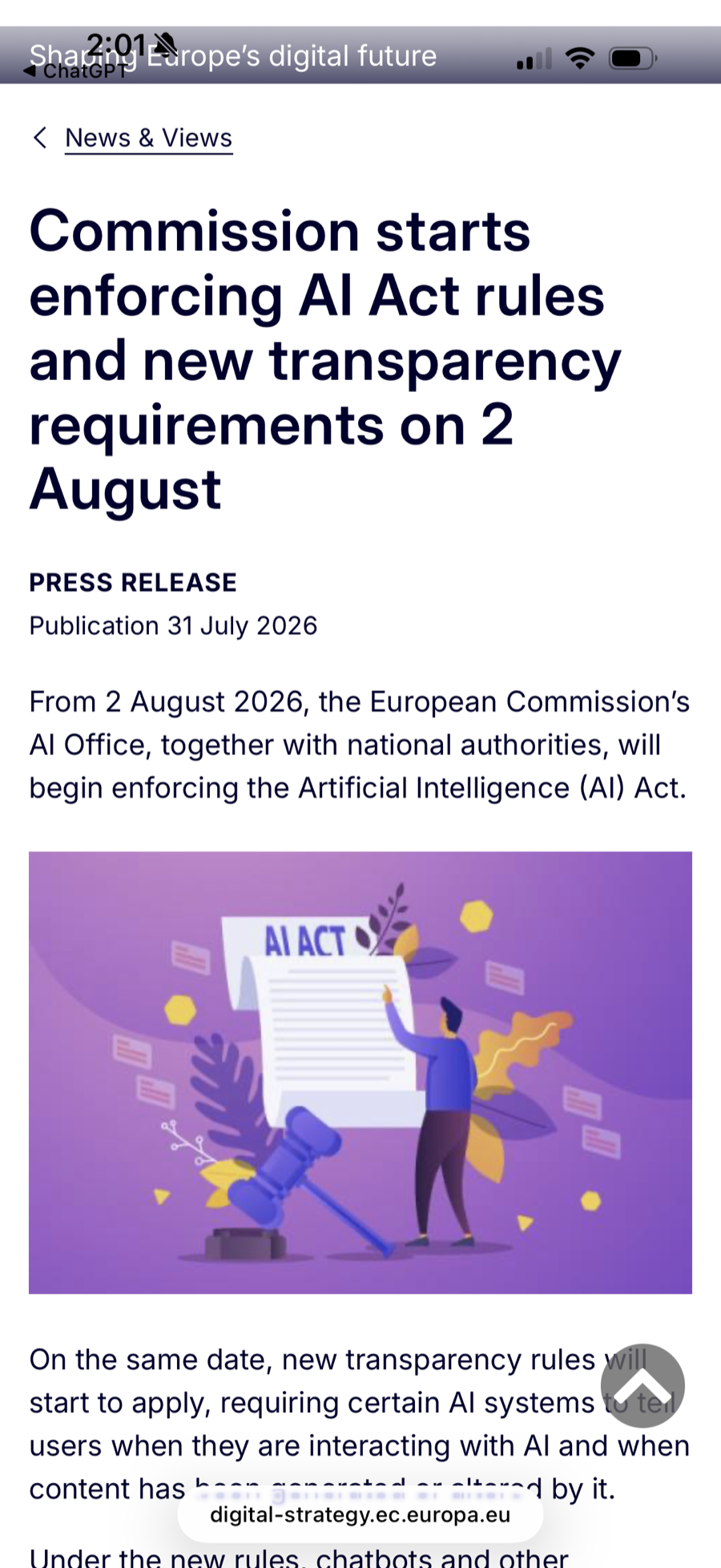
The official EU writeup is worth reading because it is not just about slapping a label on everything. The focus is on situations where people could be misled: chatbots, deepfakes, synthetic or altered media, and certain AI-generated public-interest text. Read the European Commission’s explanation here: Commission starts enforcing AI Act rules and new transparency requirements.
There are also more detailed EU guidelines on AI transparency obligations, which help explain how these requirements should work in practice.
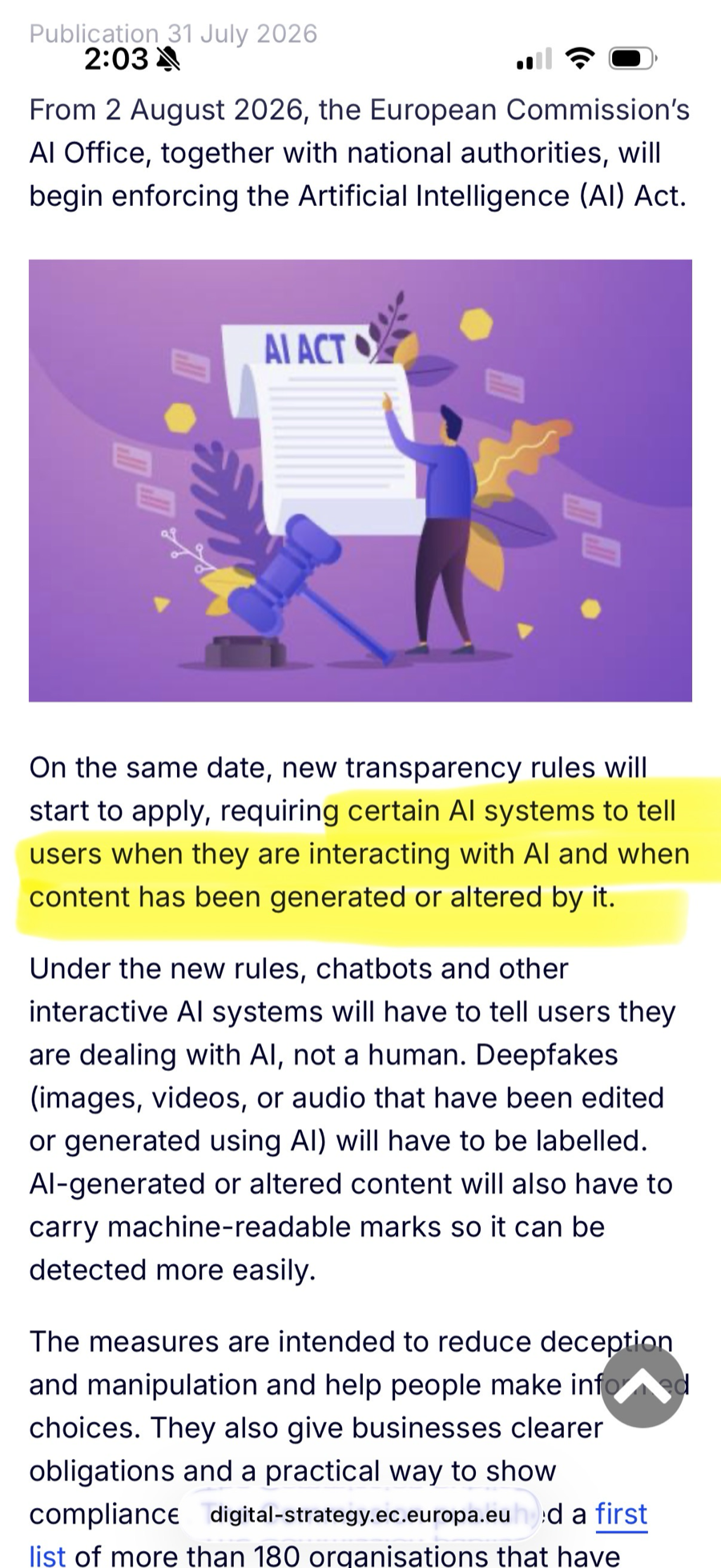
That matters because AI disclosure is not only a design choice anymore. In some places, it is becoming a legal requirement. And even outside Europe, this conversation is going to influence product design, social platforms, marketplaces, content tools, and AI startup compliance.
Why transparency actually matters
The strongest case for AI labels is simple: people should not be tricked.
If I am talking to a customer support agent, I should know if it is AI. If I am watching a video of a public figure saying something wild, I should know if it was generated or manipulated. If a romantic message, investment pitch, job offer, emergency call, or invoice was created by AI to imitate a real person, I should have some way to question it.
This is where disclosure becomes basic user safety.
The FTC has warned about AI impersonation and deepfake scams, and that is exactly the kind of thing most people are worried about. AI makes it easier to produce convincing fake voices, fake images, fake identities, and fake authority at scale.

When AI is used to deceive, the issue is not that AI exists. The issue is that the user is being denied context that would change how they interpret what they are seeing.
That is the part I keep coming back to: would the person make a different decision if they knew AI was involved? If the answer is yes, then disclosure probably matters.
The problem with labeling everything
But here is where it gets complicated.
What counts as AI use?
If I use AI to clean up grammar, does the whole article need a label? If a designer uses AI to generate background texture, does the entire flyer become AI-generated? If a developer uses AI to autocomplete code, does the app need a disclosure? If a customer support rep uses AI to summarize a conversation before replying, does the user need to know?
This is why labeling everything could get messy fast.
AI is not just a separate tool anymore. It is becoming a feature inside other tools. It is showing up in autocomplete, search, image editing, inbox sorting, meeting notes, spreadsheets, design software, analytics, code editors, and phone operating systems.
If every tiny AI-assisted action needs a warning, people may start ignoring the labels. The notice technically exists, but users stop treating it as meaningful.
A label that appears everywhere can become invisible.
That does not mean labels are useless. It means they need to be used where they actually help someone understand risk, authorship, or trust.
Where I think AI labels make sense
I think AI labels make the most sense when the user could reasonably believe something is human, real, original, official, or personally addressed when it is not.
For example, AI labels should probably be obvious when:
- A user is directly chatting with an AI system instead of a person.
- An image, video, or audio clip shows a real person doing or saying something they did not do.
- AI-generated content is being used in news, politics, finance, health, legal, hiring, education, or public safety contexts.
- A message is designed to persuade someone to send money, share private information, sign a contract, vote, buy something, or trust a fake identity.
- A product creates synthetic media that could be mistaken for a real recording.
That is where disclosure feels less like bureaucracy and more like basic honesty.
The goal should not be to punish harmless AI assistance. The goal should be to reduce deception.
Where labeling gets weird
The weird part is that not all AI use is equally meaningful.
If AI helped resize an image, nobody cares. If AI generated the face in the image, people might care a lot. If AI sorted your email inbox, that is not the same thing as AI pretending to be your boss.
So I do not think the best question is simply, “Was AI used?”
A better question might be: Was AI used in a way that changes trust, authorship, identity, or decision-making?
That is where the law and product design should probably focus.
There is also a difference between visible labels and technical provenance. Visible labels help regular users understand what they are seeing. Technical provenance helps platforms and tools verify where content came from. That is where efforts like C2PA and Content Credentials are interesting because they focus on content authenticity infrastructure, not just a random badge.
What apps and websites should do now
Even if you are not legally required to label AI use yet, it is probably smart to think about transparency now.
If you are building an app, website, AI tool, marketplace, or content workflow, ask:
- Does the user know when they are interacting with AI?
- Could this output be mistaken for a real person, real event, or official message?
- Is AI changing something the user would rely on?
- Does the app make disclosure easy instead of hiding it?
- Are labels clear, consistent, and placed near the content they describe?
- Do you have metadata or provenance for generated media?
- Can users report misleading AI-generated content?
The most practical approach is probably not one giant warning. It is contextual disclosure.
Tell users when they are talking to AI. Label synthetic media when it could be mistaken for real media. Add provenance where possible. Make the label visible enough to matter.
That is the balance.
My take
So, should hiding AI use be illegal?
My honest answer: sometimes.
I do not think every AI-assisted sentence, image edit, or workflow should become a legal issue. That would be too broad and eventually impossible to enforce in a sane way.
But I do think hiding AI use should be illegal when the lack of disclosure is part of deception, fraud, impersonation, manipulation, or a meaningful safety risk. If AI is being used to make someone believe they are talking to a human, seeing real media, hearing a real voice, or reading an authentic message, then hiding that fact can become the harm.
That is why Europe’s approach is interesting. It does not answer every edge case, but it forces the industry to take transparency seriously.
And honestly, that feels fair.
Final thoughts
AI is going to become normal. That part feels inevitable.
But normal does not mean invisible. If AI is involved in a way that affects trust, identity, safety, or decision-making, people deserve to know.
I am still on the fence about how broad the rules should be. I do not want every app to become a wall of disclaimers. But I also do not want a world where deception gets easier and the only advice is “just look closer.”
The best version of AI transparency is not about shaming people for using AI. It is about giving users enough context to make informed decisions.
What’s y’all opinion on this?
